Water Damage Basics
What counts as water damage, the three water categories, what extraction involves, what it costs and how long drying takes.
Read the water damage FAQ
Straight answers on response times, drying, costs, Florida insurance deadlines and safety, organized by topic so you can find what you need fast.
If water is in your home right now, shut off the source if it is safe, keep electricity away from wet areas, and call DryOut Inc at (607) 300-1334. We answer live 24/7, target a 60-minute arrival in core areas, and start every job with a free inspection and a written price range before any work begins.
Everything else on this page answers the questions that come after that first call: how the restoration process works, what it costs, how Florida insurance deadlines really work, and how to keep your family safe while a home is wet. Each section below gives the short answers, and each topic page goes deeper.
Each guide answers the questions our dispatchers and technicians hear most, in plain language and with Florida specifics.
What counts as water damage, the three water categories, what extraction involves, what it costs and how long drying takes.
Read the water damage FAQHow fast crews arrive, what to do while you wait, how to find your shutoff valve, and what happens in the first hour.
Read the emergency FAQFlorida claim deadlines, supplemental claims, the Assignment of Benefits ban, Xactimate scopes and what to document.
Read the insurance FAQInspection, extraction, structural drying, daily monitoring, repairs and final verification, step by step with timelines.
Read the process FAQFlooding, storm surge and wind-driven rain, plus the crucial difference between homeowners and flood insurance.
Read the storm FAQElectrical hazards, contaminated water categories, when to leave the property, and keeping children and pets safe.
Read the safety FAQWe target a 60-minute arrival for active water emergencies in our core Florida service areas, with live dispatch around the clock. Crews are stationed across 293 Florida cities, so the closest available team rolls to your address. If you are outside a core area, the dispatcher gives you an honest ETA on the call, before you commit to anything.
Stop the source if you can do it safely, for example by closing the main water shutoff valve. Turn off electricity to the wet area at the breaker, move valuables and furniture out of the water, and call us. Do not wait to see if it dries on its own. In Florida's humidity, mold can begin growing within 24 to 48 hours, and water keeps wicking into walls the whole time.
Yes. Every job starts with a free damage inspection: moisture readings, photos, a plain-language explanation of what we find, and a written scope with a price range. If the damage is minor enough to handle yourself, we will tell you that and explain how. There is no obligation to hire us after the inspection.
The process follows the ANSI/IICRC S500 standard: inspection and moisture mapping, emergency water extraction, removal of unsalvageable wet materials, structural drying with air movers and dehumidifiers, daily moisture monitoring, then cleaning, repairs and a final verified walkthrough. Each step is documented with photos and readings for your records and your insurance claim.
Most homes reach drying goals in 3 to 5 days. Hardwood, plaster, concrete and tile assemblies over wood subfloors can take longer. Your technician checks moisture levels daily, adjusts equipment as readings change, and only removes the dryers when the structure measurably meets its drying goal, not when a fixed number of days has passed.
Usually not. Extraction and drying typically run in the affected rooms while you keep using the rest of the home. Equipment is loud and rooms under drying are off limits, but most families stay. If the water is contaminated, damage spans most of the home, or utilities are shut off, we will tell you honestly if a short stay elsewhere is the safer call.
Typical Florida ranges: emergency water extraction runs $1,500 to $4,500, and structural drying for a multi-room loss runs $2,000 to $6,000. Full restoration after major flooding can reach $5,000 to $15,000 or more once drywall, flooring and cabinetry repairs are included. Your free inspection ends with a written scope and your specific price range, so there are no surprises.
The biggest factors are how much water got in, how many rooms and materials it reached, the category of the water, and how long it sat before extraction. A burst supply line caught in an hour is a drying job. The same line found after a two-week vacation can mean flooring, drywall and cabinet replacement. Speed is the cheapest variable you control.
Inspections are free, day or night. Water emergencies do not keep office hours, and neither do we: the same dispatch, the same inspection and the same written scope apply at 2 p.m. and 2 a.m. The price range we give you is the price range we work to, scoped in Xactimate like your insurer's own estimate.
Usually, if the cause was sudden and accidental: a burst pipe, a failed water heater, an appliance hose that let go. Gradual leaks, long-term seepage and poor maintenance are typically excluded, and water that rises from outside the home is flood damage, which requires a separate flood policy. We document cause and damage thoroughly so your adjuster has what they need either way.
Under current Florida law, you generally have one year from the date of loss to give your insurer notice of a claim, and up to 18 months from the date of loss to file a supplemental claim if additional related damage is discovered. Report early anyway: fresh documentation is stronger, and late notice is one of the most common reasons claims get disputed.
No. For Florida policies issued or renewed after January 1, 2023, Assignment of Benefits agreements are prohibited. You stay in control of your claim, and your insurer pays you. We support the claim with documentation, photos, moisture logs and an Xactimate scope, and we communicate with your adjuster, but the claim and the decisions remain yours.
Because Florida air is already saturated. Without dehumidification, wet drywall, wood and concrete can stay damp for weeks, and damp materials grow mold, swell, delaminate and lose strength. Professional drying controls temperature, humidity and airflow together, a science called psychrometrics, and proves the result with meters instead of guessing by touch.
In Florida's warmth and humidity, mold can begin growing on wet materials within 24 to 48 hours. That clock is the real reason emergency extraction matters: get the water out and the structure drying within the first day, and you prevent the mold problem instead of paying to fix it later. It is also why we never close up a wall until meter readings confirm it is dry.
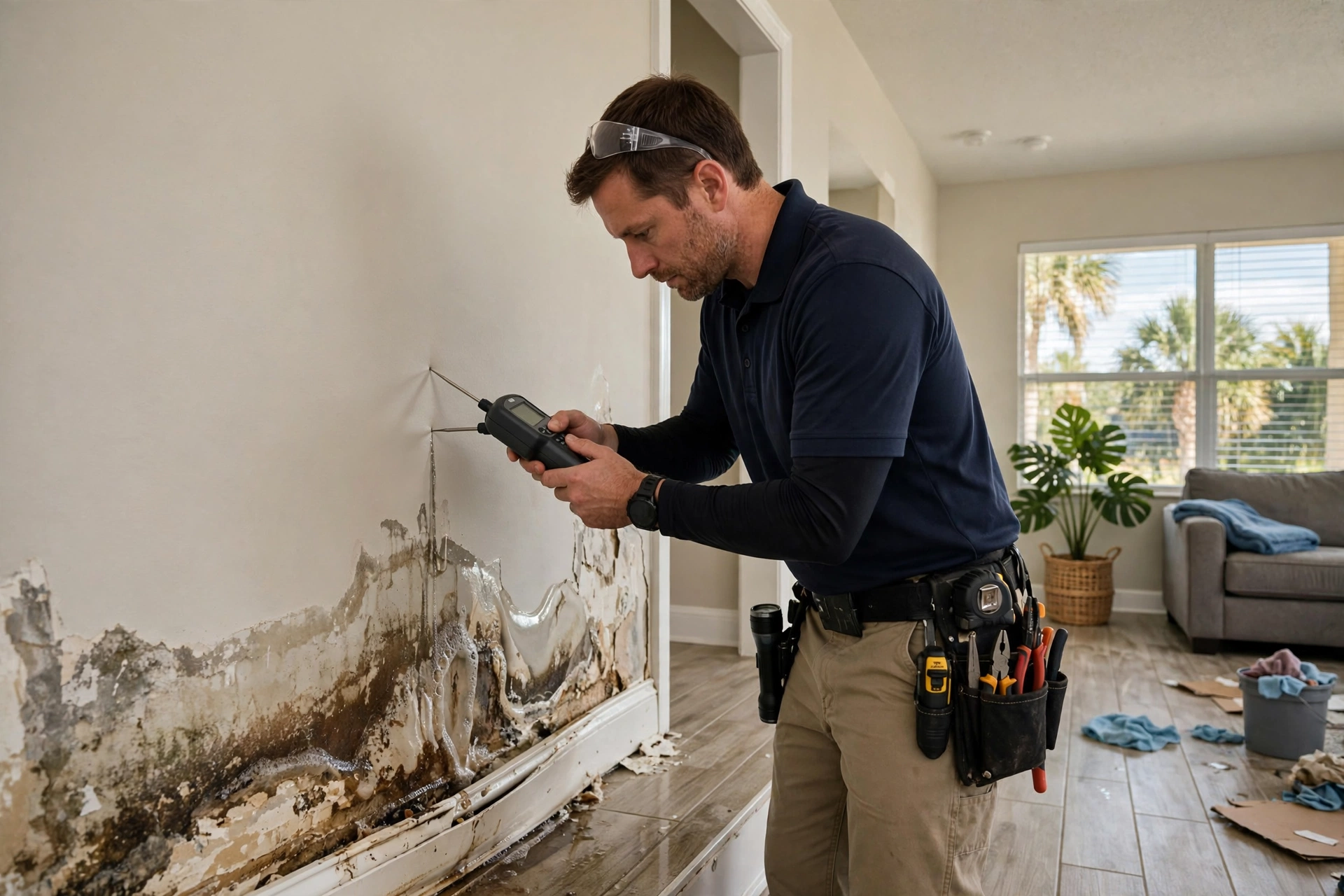
Technicians take daily moisture readings with pin and pinless meters and compare them against the moisture content of unaffected materials in the same home, the dry standard. Equipment stays until every reading meets the goal. You receive the readings log as part of your job documentation, which also supports your insurance claim.
Replace rubber washing machine and refrigerator supply hoses with braided steel lines, keep the AC condensate drain line flushed so it cannot back up into your walls, service the water heater, and know exactly where your main shutoff valve is before you ever need it. These four habits prevent or shrink the majority of the losses our crews respond to.
Shut off the main water supply whenever the property will sit empty, install a leak detection system with automatic shutoff, and have a local contact check the property after major storms. The worst losses we see are not the biggest leaks; they are ordinary leaks in empty homes that ran for weeks. A $30 hose failure becomes a $30,000 renovation when nobody is home.
Walk the ceilings and exterior walls looking for stains, bubbling paint or dripping, check around windows and sliding doors for intrusion, and look in the attic for wet insulation if any roofing was damaged. Wind-driven rain enters in surprising places. Photograph anything you find and call for a free moisture inspection if you see staining or smell mustiness.
Call now and talk to a live dispatcher, not a machine. Free inspection, honest scope, and a crew that can be on its way in minutes.
Call 24/7: (607) 300-1334