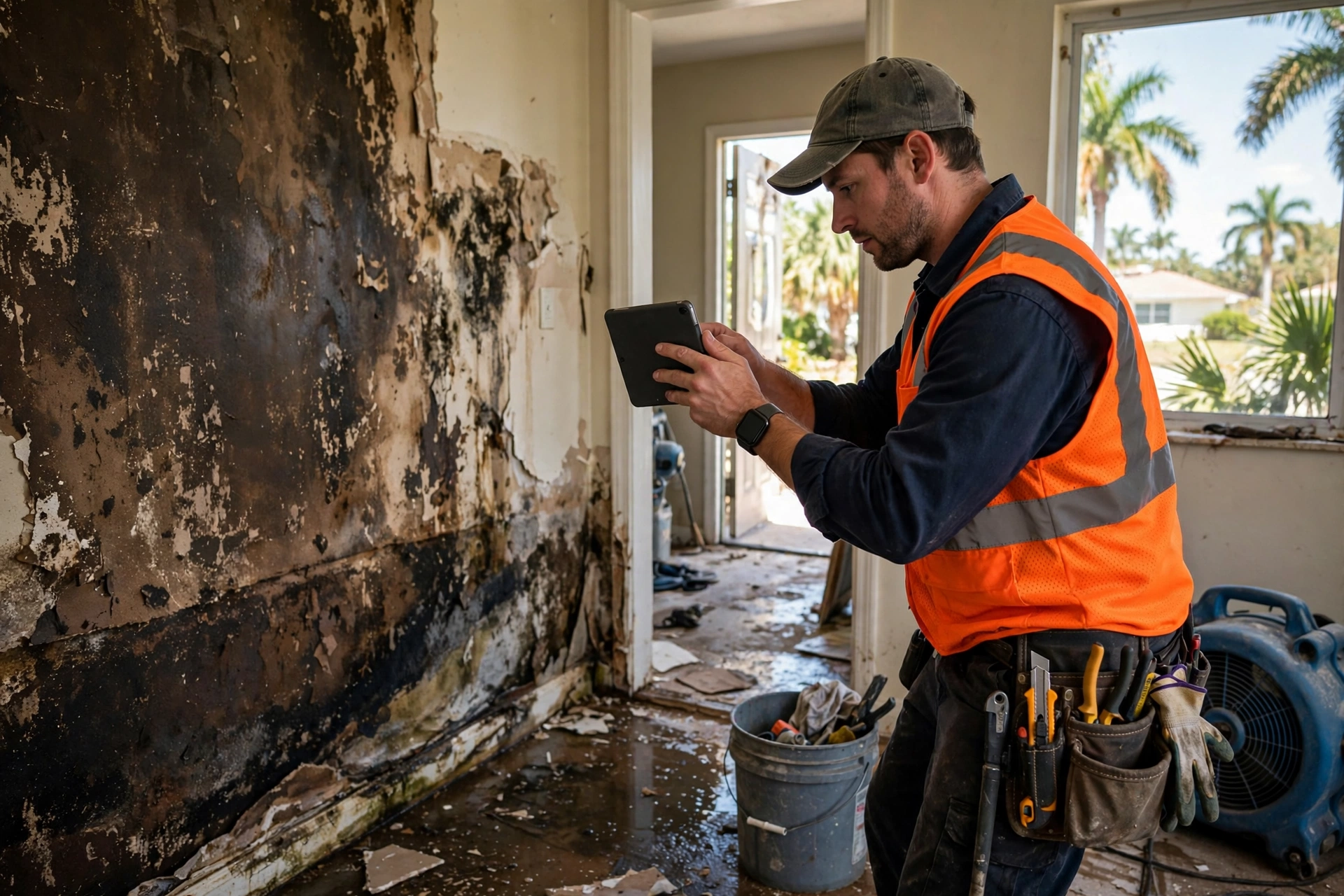
A Florida water damage claim runs: document and mitigate on day one, notify your insurer within days, get an inspection and adjuster visit within weeks, and receive payment weeks after that. Florida law gives you one year from the date of loss to report and up to 18 months for supplemental claims. Documentation quality decides the speed more than anything else.
Most homeowners imagine an insurance claim as a single event: you call, they pay. The reality is a sequence, and each stage has its own clock. Understanding that sequence is what separates claims that pay fairly in weeks from claims that drag into disputes for months. This guide walks the whole timeline for a Florida water damage claim, with the deadlines that actually matter and the spots where good documentation keeps things moving. For step-by-step help with the paperwork, see our insurance claims assistance service.
Day one: what should happen before you call your insurer?
Two things, in this order: document and mitigate. Photograph and video every affected room, the water source or failed part, water lines on walls and every damaged item, before anything is cleaned up or moved. Then start emergency mitigation: stop the source, shut off power to wet areas, and call a restoration company for extraction. Your policy requires you to prevent further damage, so waiting days for an adjuster while water sits in your walls is exactly the wrong move. Our water extraction crews also photograph, meter and document as they work, so the professional record starts at hour one.
While the crew works, call your insurer's claims line and open the claim. Give the date of loss, the cause as you understand it, and your policy number. This call starts the official timeline; in Florida you have up to one year from the date of loss to give notice, but same-day or next-day reporting produces the strongest claims.
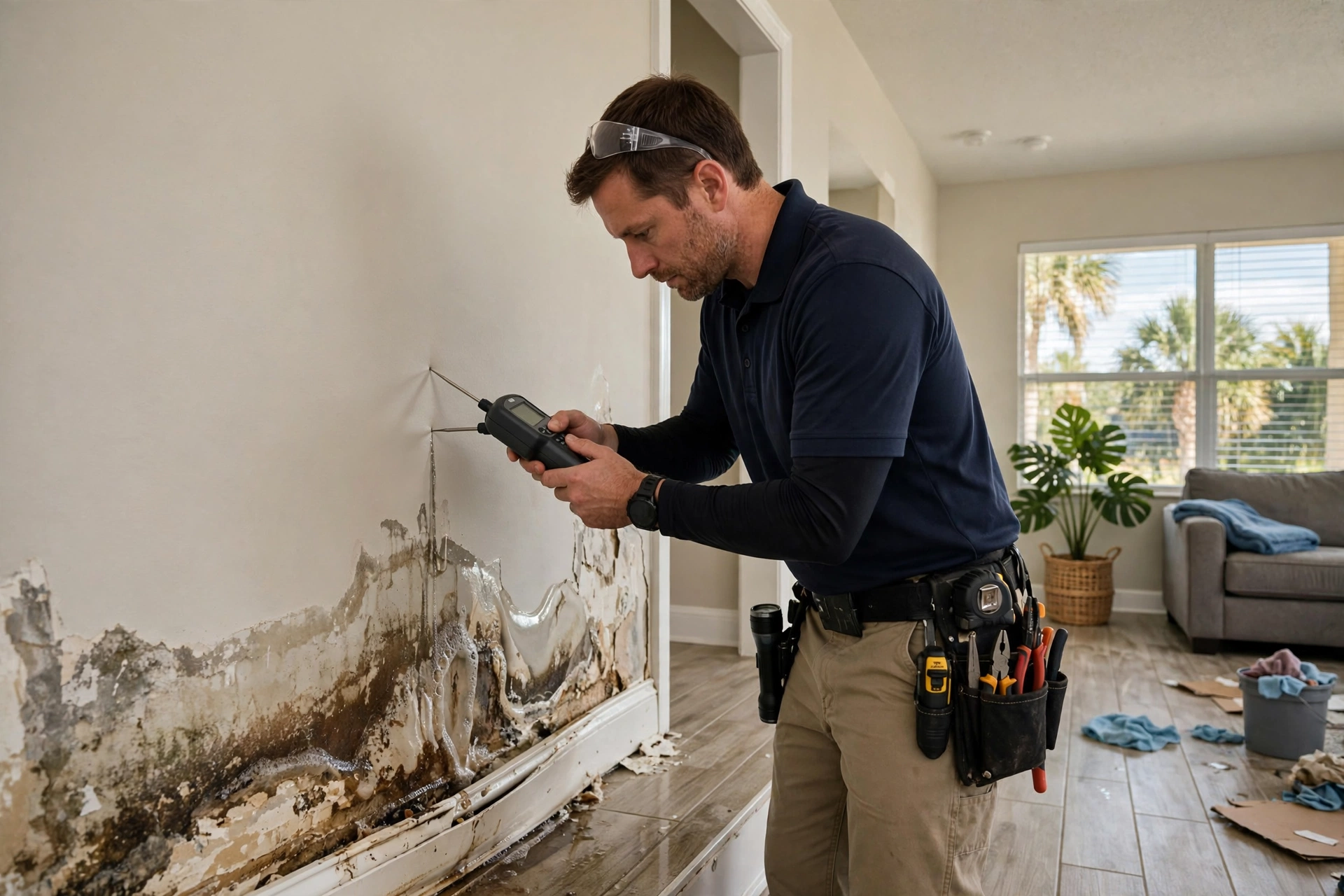
Weeks one to two: what does the adjuster do?
Your insurer assigns a claim number and an adjuster, usually within days for water losses. The adjuster visits to inspect the damage, take their own photos, and verify the cause against your coverage. This is where your documentation earns its keep: before-and-after photos, moisture maps, the crew's daily drying logs and a line-item scope written in Xactimate let the adjuster verify quickly instead of scheduling a second visit or asking for more evidence. If your restoration company's scope and the adjuster's scope disagree on price or scope, the mismatch is usually resolved faster when both are built from the same documented evidence.
What are Florida's claim deadlines, and why do they matter?
Three deadlines shape every Florida claim. First, you generally have one year from the date of loss to notify your insurer; miss it and the claim can be denied outright. Second, you generally have up to 18 months from the date of loss to file a supplemental claim for related damage discovered later, which is common in water losses when demolition reveals hidden moisture. Third, flood insurance through the National Flood Insurance Program has its own strict proof-of-loss deadline, commonly 60 days, so flood claims must start immediately. Do not let the generous one-year number make you casual: late notice is one of the most common reasons claims get disputed, and fresh documentation is always stronger.
How does the AOB ban change how claims are handled?
Assignment of Benefits agreements, where a contractor took over your claim and dealt with your insurer in your name, are prohibited for Florida policies issued or renewed after January 1, 2023. In practice, this means your claim stays in your name, decisions stay yours, and the insurer pays you directly. Your restoration company supports the claim with documentation, meets the adjuster on site and scopes the work, but cannot take over the claim itself. If any contractor asks you to sign an AOB on a current policy, that is a red flag: Florida law no longer allows it. More in our insurance documentation FAQ.

What is a supplemental claim, and when should you file one?
A supplemental claim asks your insurer to pay for additional damage from the same loss that was not in the original claim: hidden moisture found during demolition, materials that cannot be saved after all, or drying costs that ran longer than estimated. File it when the evidence supports it, with the same documentation discipline as the original: photos, readings and the Xactimate line items. Florida gives you up to 18 months from the date of loss. The claims that win supplemental payments are the ones whose original documentation was thorough, because the adjuster can see the new damage is genuinely part of the same event.
Where do water damage claims usually stall, and how do you prevent it?
Three stalls repeat endlessly. The first is late reporting with thin documentation, which invites disputes about the date and cause of loss. The second is a scope mismatch: your estimate says one thing, the adjuster's says another, and neither side has itemized evidence. The third is silence: homeowners who stop responding to adjuster requests because they do not understand what is being asked. Prevention is the same in all three: report fast, document everything from hour one, and keep the same evidence package in front of everyone. A restoration company that scopes in Xactimate and ships the adjuster a complete file on day one removes most of the friction that makes claims drag. In our 293 Florida service areas, this documentation discipline is standard on every job.
When should you escalate a denied or underpaid claim?
Start with the paperwork: get the denial or underpayment reason in writing and compare it against your documentation. Many disputes resolve at this stage with a supplemental submission that fills the evidence gap. If not, your options scale up: request re-inspection by the insurer, invoke your policy's appraisal process, file a complaint with the Florida Department of Financial Services, or consult a Florida public adjuster or property insurance attorney for larger amounts. Escalation works best from a position of documented strength, which is exactly why the day-one documentation steps in this guide matter so much.
What should you do if the adjuster's scope misses hidden damage?
This happens often enough to plan for it. The adjuster's inspection usually happens before demolition, and water hides: soaked insulation behind a drywall surface that feels dry, moisture under vinyl flooring, cabinets that wicked water into toe kicks. When your crew's demolition and meters reveal that hidden damage, the correct move is a documented supplemental claim, not an argument. The crew photographs and meters the newly exposed areas, writes the additional scope in Xactimate tied to the same date of loss, and submits it with the original moisture logs showing the damage path from day one. That evidence chain is what converts a miss into an approval. Florida's 18-month supplemental window exists precisely for these findings, so keep every record. The one caution: never authorize repair work that goes far outside the claim scope before the supplemental is filed, unless it is necessary mitigation, because insurers pay for documented necessity, not surprise extras.
How long do Florida water damage claims usually take from start to finish?
For a straightforward insured loss with clean documentation, expect the sequence to take roughly four to ten weeks: day-one mitigation and claim notice, adjuster visit in weeks one to two, scope agreement and first payment in weeks three to five, repairs running in parallel as early as week two, and supplemental items settled by weeks six to ten. Water losses are among the fastest large claims because the damage is physical and measurable. The cases that stretch to months are almost always the cases with thin documentation, late notice, coverage ambiguity like gradual versus sudden, or storm backlogs after landfalls. You cannot control the adjuster queue, but you control the first week entirely, and the first week is where claims are won or lost. Our insurance documentation FAQ lists the exact evidence package to keep claims moving.